

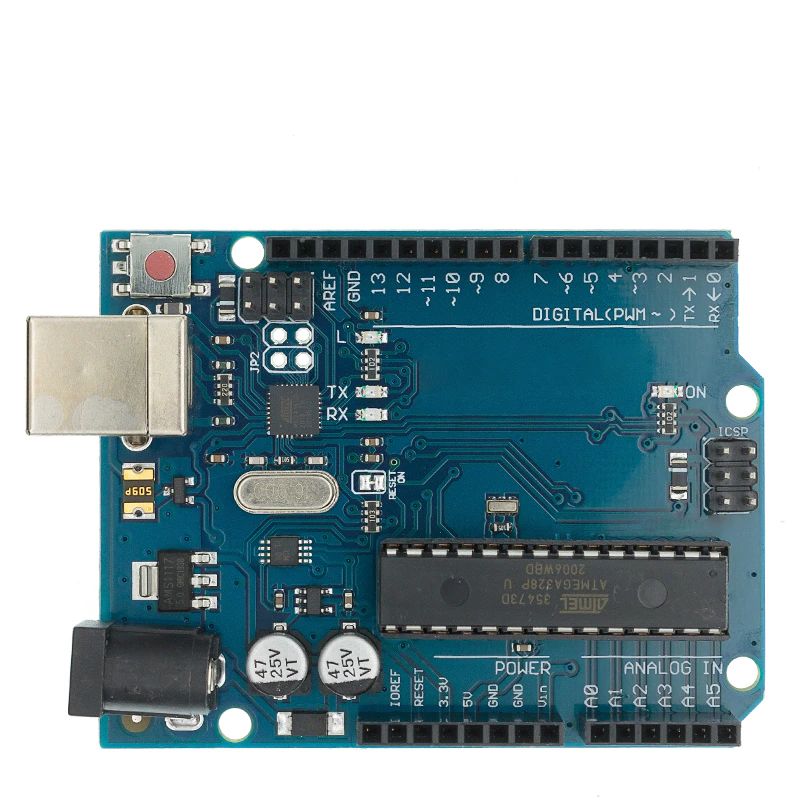
Arduino UNO R3 compatible board built around the classic ATmega328P @ 16 MHz. It combines 14 digital I/O (6 PWM), 6 analog inputs, solid 5 V logic, and full compatibility with the huge ecosystem of Arduino shields, sensors, and displays. Ideal as a first microcontroller board or a dependable workhorse for prototyping and embedded projects.
Why Makers Choose This UNO R3-Compatible Board
- Beginner-friendly & well-documented: Works with the standard Arduino IDE, examples, and libraries out of the box.
- 5 V shield compatibility: R3 footprint and pinout mean instant add-ons for motor control, Ethernet, LCDs, relays, and more.
- Flexible power options: Program via USB-B; power from USB or DC jack (recommended 7–12 V) for standalone projects.
- Reliable platform: Stable hardware design that’s great for repeated use in labs, classrooms, or project benches.
What You Can Build
- STEM projects: traffic lights, temperature loggers, distance meters, datalogging with RTC + microSD
- Home & hobby: smart plant watering (relay + soil sensor), door alarms (PIR), IR remote controllers
- Robotics: line followers and 2WD cars with motor shields and IMU/ToF sensors
- Wearables & interaction: LED wearables, sound-reactive lights, simple MIDI controllers
- IoT & automation: connect to WiFi modules, log data, and control relays or actuators
Starter Bundles (Quick Picks)
- UNO Learning Kit: UNO R3-compatible board + USB-B cable + breadboard & jumpers + basic sensors + 0.96″ OLED
- Sensor Lab: UNO R3-compatible board + BME280 + HC-SR04 + relay + data logging shield
- Robot Starter: UNO R3-compatible board + 2WD chassis + L293D/TB6612 shield + battery/PSU
Recommended Add-Ons
- USB-B cable for programming and power
- Sensor packs (DHT22, PIR, HC-SR04, IMU, light)
- Displays (1602 LCD, OLED, TFT)
- Arduino shields (motor, relay, Ethernet, proto)
- 5 V/9 V/12 V power supplies & 5.5×2.1 mm barrel adapters
- Tools (soldering, tweezers) & multimeter for troubleshooting
- Cases & mounting (clear acrylic, ABS, DIN-rail)
Technical Specifications
| Microcontroller | ATmega328P (8-bit AVR) @ 16 MHz |
| Operating voltage | 5 V logic |
| Input voltage (recommended) | 7–12 V via DC jack (6–20 V allowable) |
| Digital I/O pins | 14 (D0–D13), 6 PWM (D3, D5, D6, D9, D10, D11) |
| Analog inputs | 6 (A0–A5), 10-bit ADC |
| Per-pin DC current | 20 mA (do not exceed absolute max) |
| Flash / SRAM / EEPROM | 32 KB (0.5 KB bootloader) / 2 KB / 1 KB |
| Interfaces | UART (D0/D1), I²C (A4/A5), SPI (ICSP header) |
| USB interface | USB-to-serial (chip may vary: ATmega16U2, CH340, etc.) |
| USB connector | USB-B |
| Power connectors | USB 5 V, DC barrel jack 5.5×2.1 mm (center-positive), VIN, 5V, 3V3, GND |
| On-board features | RESET button, AREF, ICSP, LED_BUILTIN (D13) |
| Dimensions | Approx. 68.6 × 53.4 mm (R3 footprint) |
Pinout & Power Tips
- SPI via ICSP: Use the 6-pin ICSP header for reliable SPI (also handy when using shields).
- Level safety: UNO-style boards are 5 V. If a module is 3.3 V-only, add a logic level converter.
- Power sources: For portable builds, power via DC jack or VIN (7–12 V recommended). For bench work, USB is fine.
- Grounding: Always share GND between the board, sensors, and external modules for stable readings.
Learning Path (Beginner → Intermediate)
- Blink & Inputs: LED blink, button debounce, tone/buzzer
- Sensing: DHT22 temp/humidity, HC-SR04 distance, LDR light
- Outputs: relays, servos, LCD/OLED
- Data logging: microSD + RTC shield, graphs & alerts
- Motion & robots: motor shield + 2WD/4WD chassis + IMU
What’s in the Box
- 1 × Arduino UNO R3-compatible board (ATmega328P)
Compatibility & Notes
- Shields: R3 footprint with full 5 V logic for maximum shield compatibility.
- Drivers: Some compatible boards use CH340/CP2102 USB-to-serial chips and may require a driver install on certain systems.
- UNO R3 vs other boards: Newer boards may offer more performance or USB-C, but the UNO R3 ecosystem remains the most widely supported and documented.
FAQs – Arduino UNO R3-Compatible Board
Is this beginner-friendly?
Yes. UNO-style boards are the most widely used Arduino-compatible boards for first projects—simple setup, massive library support, and plenty of tutorials.
Which cable and power supply do I need?
Use a USB-B cable for programming. For standalone projects, power via the DC barrel jack (7–12 V recommended) or a regulated 5 V rail to the 5V pin.
Will my shields and modules work?
Yes—this board uses the standard R3 footprint and 5 V logic. Use a level shifter when connecting 3.3 V-only modules.
Do I need to install drivers?
Most operating systems recognize official USB chips automatically. If your board uses a CH340/CP2102, you may need to install the corresponding USB-to-serial driver.
Uno R3 Board ATMEGA328 Arduino Compatible
Uno R3 Board ATMEGA328 Arduino Compatible
Out of stock
Product Code
SKU:AE007
Regular price
₱ 315.00
Regular price
Sale price
₱ 315.00
Unit price
per
Couldn't load pickup availability
