


Fingerprint Sensor AS608 - A Beginner's Guide
One touch can replace keys. This project uses an optical fingerprint sensor to enroll users and then grant access with a quick scan.
read tutorial →
These boost (step-up) voltage regulators generate higher output voltages from input voltages as low as 2.5 V. They are switching regulators (also called switched-mode power supplies (SMPS) or DC-to-DC converters) and have a typical efficiency between 80% to 90%. The available output current is a function of the input voltage, output voltage, and efficiency (see Typical Efficiency and Output Current section below), but the input current can typically be as high as 1.4 A.
The regulator’s thermal shutdown prevents damage from overheating, but it does not have short-circuit or reverse-voltage protection.
 |
 |
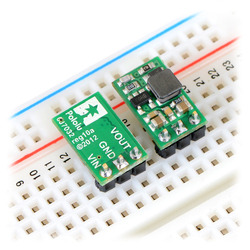
The boost regulator has three connections: input voltage (VIN), ground (GND), and output voltage (VOUT).
The input voltage, VIN, must be at least 2.5 V and should not exceed the output voltage, VOUT. Please be wary of destructive LC spikes that might cause the input voltage to exceed VOUT (see below for more information).
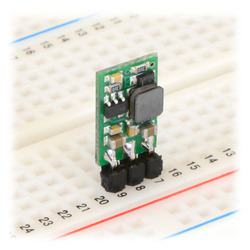
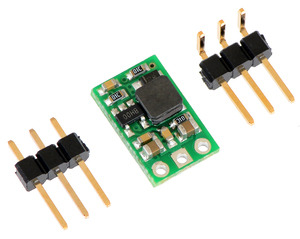
The three connections are labeled on the back side of the PCB, and they are arranged with a 0.1″ spacing along the edge of the board for compatibility with solderless breadboards, connectors, and other prototyping arrangements that use a 0.1″ grid. You can solder wires directly to the board or solder in either the 3×1 straight male header strip or the 3×1 right-angle male header strip that is included.
 |
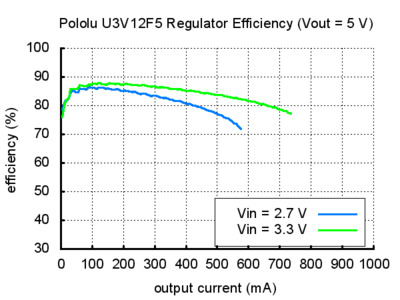
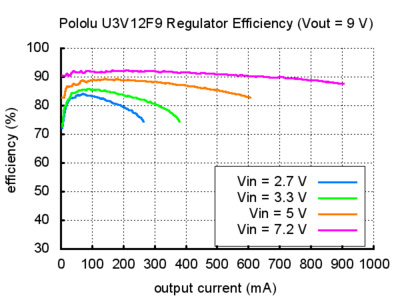
The efficiency of a voltage regulator, defined as (Power out)/(Power in), is an important measure of its performance, especially when battery life or heat are concerns. As shown in the graphs below, this switching regulator typically has an efficiency of 80 to 90%.
 |
 |
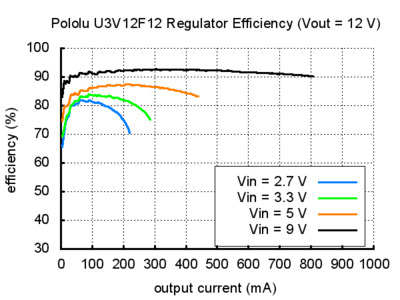 |
The maximum achievable output current is approximately proportional to the ratio of the input voltage to the output voltage. If the input current exceeds the switch current limit (typically somewhere between 1.4 and 2 A), the output voltage will begin to drop. Additionally, the maximum output current can depend on other factors, including the ambient temperature, air flow, and heat sinking.
When connecting voltage to electronic circuits, the initial rush of current can cause damaging voltage spikes that are much higher than the input voltage. In our tests with typical power leads (~30″ test clips), input voltages above 10 V caused voltage spikes in excess of 20 V. You can suppress such spikes by soldering a 33μF or larger electrolytic capacitor close to the regulator between VIN and GND.
| Size: | 0.32″ × 0.515″ × 0.1″1 |
|---|---|
| Weight: | 0.4 g1 |
| Minimum operating voltage: | 2.5 V |
|---|---|
| Maximum operating voltage: | 9 V |
| Maximum input current: | 1.4 A2 |
| Output voltage: | 9 V |
| Reverse voltage protection?: | N |
| Maximum quiescent current: | 2 mA |
| PCB dev codes: | reg10a |
|---|---|
| Other PCB markings: | 0J7032 |
Manila stock. Order before 16:00 PHT, ships today via J&T or LBC. Provincial: 1–3 working days.
Schools / class POs: we accept Purchase Orders for accredited schools and universities. contact us with your PO details.
Returns: 7-day inspection window for DOA units. Email proof of issue and we ship a replacement.
One touch can replace keys. This project uses an optical fingerprint sensor to enroll users and then grant access with a quick scan.
read tutorial →Wire a joystick to your Arduino, read X/Y, then print UP / DOWN / LEFT / RIGHT to the serial monitor.
read tutorial →Bench-test a 43 A motor driver before wiring the full project. Catches weak power, mis-pinning, and dead boards before they cost you time.
read tutorial →Coming from UNO and the Pico won't show a COM port? Here's the BOOTSEL trick, the driver fix, and the first sketch that actually works.
read tutorial →Share what you built. Photos, BOM, what worked, what didn't.
view thread →Symptom + what you tried + clear photo = answers within hours.
view thread →Brownout reset when adding a sensor? Notes on supply decoupling and GPIO checks.
view thread →Upload failing on your first Uno? Driver, COM port, board match — checklist inside.
view thread →